Alan Turing

Credit: Wikimedia Commons
Alan Turing was born in 1912 and died by suicide in 1954. He was a huge part of Britain winning the second world war. It is said that without his help the war would have gone on for at least another 2 years. This means he was able to save a lot of people’s lives. It was important that the work that Turing did during the war remained secret.
In 1952 when Turing was convicted of “gross indecency” with another man and forced to take oestrogen tablets, no one knew just how much of a hero he was. Sadly after 2 years of the treatment Turing could take no more and poisoned himself in 1954.
In 2013 (60 years later) Queen Elizabeth 2nd gave Turning a posthumous royal pardon. Justice Secretary Chris Grayling said that Alan Turing “deserves to be remembered and recognised for his fantastic contribution to the war effort and his legacy to science”.
The Enigma machine
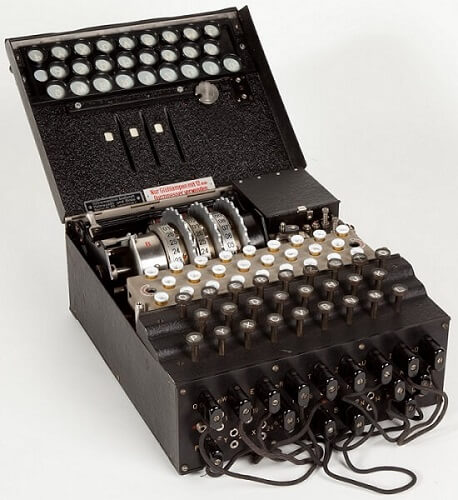
Credit: Wikimedia Commons
The Enigma Machine was used by the Germans to scramble their messages. It would produce encoded messages so that if the messages were intercepted, no one would not know the German plans. The only way to decipher the message was to know the Enigma settings for that day.
However due to the fact the Germans wanted it to be impossible to break they regularly changed the settings. That meant that even if someone cracked one day’s settings it does not mean it will work the next day.
Enigma had so many different variations of the settings meaning it would take someone years and years to test all the possible options. However, they would only have a few hours to crack it.
Here is a video that explains what the Enigma machine is and how Alan Turing was able to break it.
If you would like to get a better idea of Alan Turing’s life I would recommend watching ‘the Imitation Game’ which was released in 2014. It follows his life story and enables you to get an idea on what he went through.
In the movie the machine Alan Turing uses to break enigma was called Christopher. His design for the machine was used to make a device we all use today. Christopher was considered the first steps to making a computer.